You might assume, therefore, that the members of the
team share similar viewpoints in the lead up to the trades
we make across our portfolios. After all, everything from
our quarterly asset allocation commentary to the fact that
we publish our portfolios on COMMunity Link
®
could
imply that we ascribe to a unified “house view.”
But the reality is more nuanced and, we would argue,
much healthier for your clients’ portfolios. The four
members of the team, all of whom are CFA
®
charterholders,
bring varying and sometimes disparate perspectives to
the table and thoroughly debate every decision the team
makes. The portfolios are only traded after this process
occurs and a team consensus is reached. Rather than
discussing in abstract terms, let’s review how the team
worked together to implement three recent trades.
The REIT Trade
Advisors may be interested to learn that the allocation to
a real estate investment trust (REIT) fund in many of
our portfolios has sparked vigorous discussion within our
group, not just over the past few months but over the
past couple of years. One reason for this is that we consider
REITs to be an out-of-benchmark bet because we measure
ourselves against the Russell 3000 Index. Consequently,
REIT returns have a larger-than-normal effect on the
relative performance of our portfolios.
Over the span of two years, on what seemed like a monthly
basis, a couple of our team members brought up the topic
of REITs in our weekly meetings, primarily arguing the
bear case. They were concerned that valuations had become
stretched and that a rise in interest rates could have a
negative effect on investor demand for REITs and on
REITs’ ability to self-finance. They also pointed out that
the U.S. REIT space was relatively small—with only
125 stocks in the MSCI U.S. REIT Index—which
limited the universe available to active managers.
Others in our group argued the bull case, asserting that
commercial property market fundamentals had been
improving, that rates had remained at or near historically
low levels, and that REITs offered diversification relative
to other holdings in our portfolios. Both the bears and
bulls on our team presented research supporting their views.
Last May, the scales ultimately tipped, when the bullish
members of the team softened their support for the REIT
asset class because interest rates were so low that there was
a particularly high risk of a rise in rates. Consequently, the
team made a consensus decision to reduce the allocation
to REITs across the portfolios with exposure to this area.
As it turns out, the timing of our decision to lighten
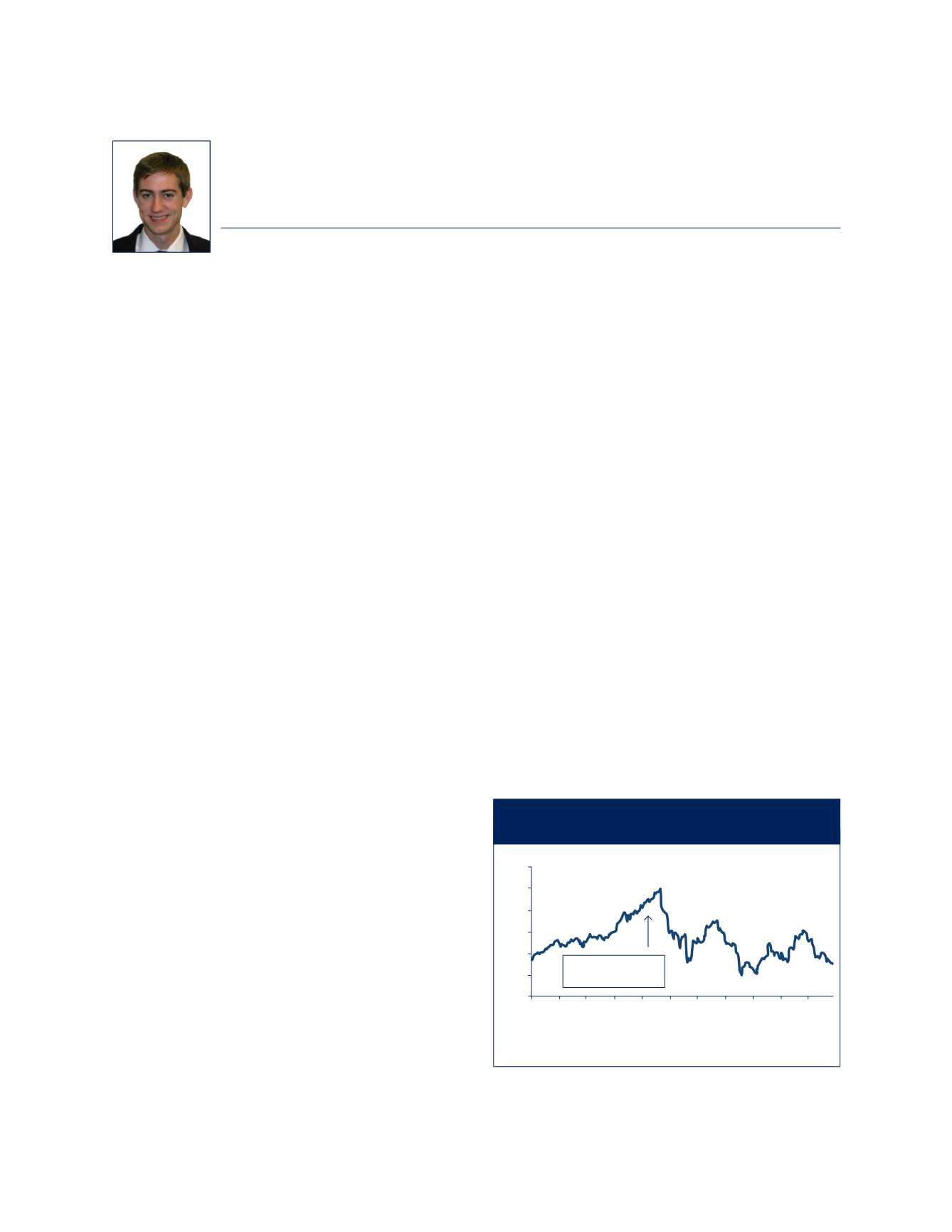
REIT exposure has been favorable so far. Soon after we
made the trade, taper rumors caused a significant pullback
in the asset class (see Figure 1). Although we cannot claim
to have anticipated the exact timing of Chairman Bernanke’s
May 22, 2013, comments that engendered the taper rumors,
we believe that this example illustrates how our team
structure helped us make better decisions than we might
have made acting individually. If the bears had been in
charge, we would have traded out of the asset class too
early and given up future gains. If the bulls had had their
way, we might have stood pat or even increased our
position at the wrong time.
E Pluribus Unum: How the PPS Select Team
Forms Consensus Decisions
SEAN FULLERTON, CFA®
When it comes to choosing a new investment or making a portfolio change, the
Preferred Portfolio Services
®
(PPS) Select team acts together rather than individually.
20
For Advisor Use Only
January/February
2014
REIT Exposure
Reduced
1120
1070
1020
970
920
870
820
12/31/12
1/31/13
2/28/13
3/31/13
4/30/13
5/31/13
6/30/13
7/31/13
8/31/13
9/30/13
10/31/13
Source: Bloomberg
Figure 1. Performance of MSCI U.S. REIT Index,
December 2012–November 2013
Wealth Management
/ Investments & Research


