The Municipal Fund Trade
In addition to spending time on allocation decisions, the
PPS Select team devotes significant effort to making what
we believe are the right fund selections. An example of
how we do this took place in October 2012, when we
replaced a long-standing municipal bond fund.
This was a fairly contentious decision for us because the
original fund had delivered excellent performance over
the previous few years. Because of its longer-than-average
duration and higher portfolio concentration, the fund’s
management team had been successful in riding both the
decline in rates and the tightening of spreads between high
and medium credit-quality issuers.
Despite the fund’s successes, however, one team member
pointed out the risks associated with a long-duration,
lower-quality-oriented portfolio. From a contrarian
perspective, a recent decline in rates and tightening of
spreads had made these areas less attractive. The fund
also had a history of either performing in the very top
few percentiles of its peer group or in the very bottom.
For these reasons, he argued that it made sense to sell
the fund at the top. Other members of the team were
skeptical at first, but the evidence suggested that a change
did indeed make sense.
After culling the universe of municipal bond funds and
organizing meetings with a variety of portfolio managers,
the team settled on the
Franklin Federal Tax-Free Income
Fund (FAFTX)
as a replacement. We liked that the fund
had a history of conservative, consistent management under
the watch of a tenured and stable team. Its duration was
more than a year shorter than our original manager, the
credit quality tended to be a bit higher, and the portfolio
was more diversified.
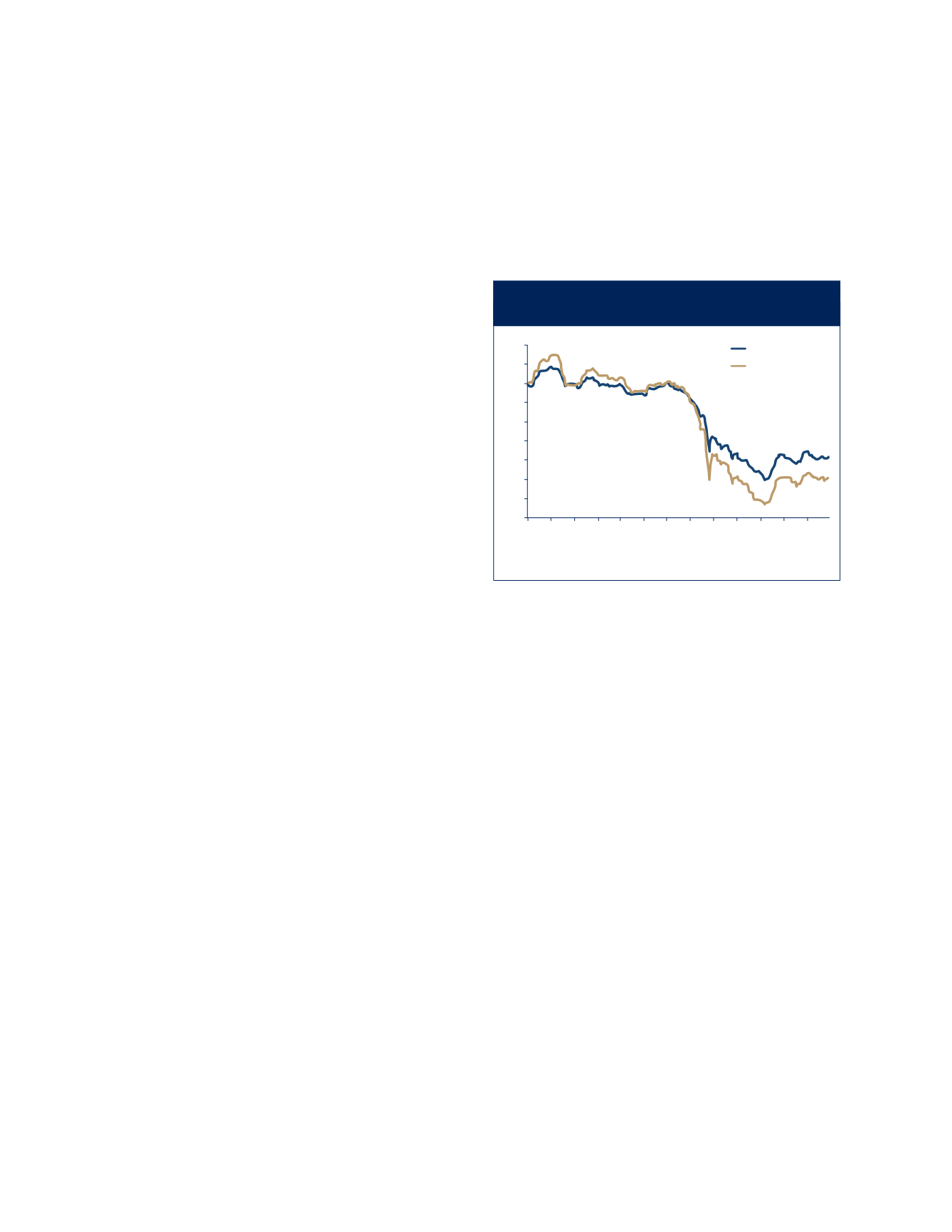
Over the next couple of months, interest rates moved
lower, helping the relative performance of our original
fund and hurting the performance of our replacement.
Had we erred in making the switch? Because we had
thoroughly vetted the decision and agreed as a group to
make the trade, we avoided the temptation to admit
defeat and alter the portfolios again.
And the team’s solidarity ultimately paid off. As the interest
rate environment changed during 2013, the new fund
held up better in the face of asset class-level headwinds.
One more note . . . looking at Figure 2, some might ask
why we maintained exposure to the asset class at all. We
accept and understand that, in most market environments,
some portion of our portfolios will have a tendency to
underperform. We see this as a positive. It means that the
portfolios are diversified with assets that have low correlations
to one another. Although the municipal bond portion of
the portfolios struggled in 2013, strong equity market
performance helped the portfolios gain ground overall.
The International Trade
Since before the financial crisis, the PPS Select team had
maintained an underweight to developed international
equities. This was primarily due to our concerns about the
economic and political situation in Europe, as well as our
relatively more optimistic view on prospects here in the U.S.
But our calculus began to change in mid-2012, when
European Central Bank President Mario Draghi pledged
to support the euro at any cost. Another major factor was
commonwealth.com
For Advisor Use Only
21
FAFTX
Previous Fund
104
102
100
98
96
94
92
90
88
86
10/31/12
11/30/12
12/31/12
1/31/13
2/28/13
3/31/13
4/30/13
5/31/13
6/30/13
7/31/13
8/31/13
9/30/13
10/31/13
Source: Bloomberg
Figure 2. Franklin Federal Tax-Free Income Fund Vs.
Previous Holding, October 2012–November 2013
Wealth Management
/ Investments & Research


