Wealth Management
/ Investments & Research
commonwealth.com
For Advisor Use Only
19
Decades of bad habits can wreak havoc on an individual’s
long-term plans, and decisions made in an investor’s 20s
and early 30s may have more of an impact on his or her
golden years than most people realize.
Unfortunately, young investors are often undereducated
about how to approach investing and accumulating sufficient
assets for retirement. And this problem is intensifying as
industries move from defined-benefit structures toward
defined-contribution frameworks. Now, more than ever,
young investors hold the keys to their own financial futures.
It’s our job as analysts and advisors to provide much-needed
tutelage to inexperienced clients. Here we address a few
of the major issues that disproportionately affect fledgling
investors and provide food for thought for advisors who
may be spending the majority of their time working with
the older demographics.
Compounding Is a Young Investor’s
Best Friend—and a Benefit to Advisors
Albert Einstein once quipped that “compound interest is
the most powerful force in the universe.” Most advisors and
clients would likely agree with his assertion that a longer
time horizon allows investments to grow due to the effect
of compounding. The sheer scale of this benefit is best
demonstrated by way of an illustration.
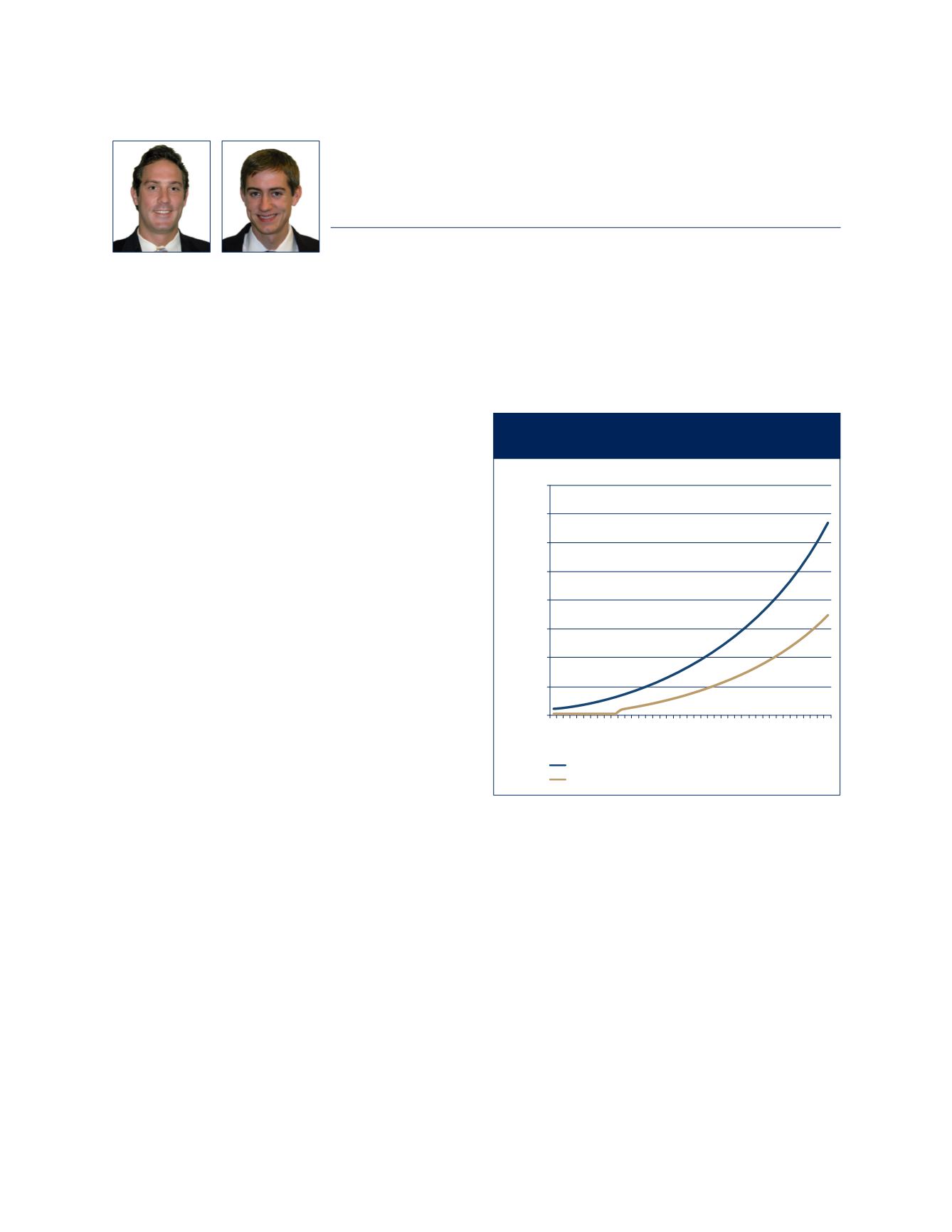
We compared the hypothetical portfolio growth of two
young clients. Both investors begin with $20,000 up front,
and both contribute $3,000 per year to their portfolios
until retirement; Client A, however, starts investing this
year, while Client B waits 10 years before starting to invest.
Using simple arithmetic, we would expect Client A to end
up with $30,000 (i.e., $3,000 x 10 years) more in the
bank at retirement than Client B. But that doesn’t take
compounding into account.
Let’s assume that both clients’ investments grow at a
6-percent rate. Because of compounding, after 40 years
have elapsed, Client A will actually end up with nearly
double the assets of Client B, simply because she took the
initiative to start saving and investing earlier (see Figure 1).
This exponential growth of investable assets not only
benefits clients, but also helps advisors, who will likely garner
higher fee-based revenues. For example, after 13 years, Client
A’s $20,000 portfolio would grow to nearly $100,000, and,
after 22 years, it could reach $200,000.
Because younger investors on average have a higher ability
to take risk, advisors can expect the value of their portfolios
to potentially grow at a faster rate. This could be helpful
Longevity and the Power of Compounding
Make Younger Investors a Unique Opportunity
PETER ESSELE, CFA®, AND SEAN FULLERTON, CFA®
Many investors believe that the most important period for wealth accumulation is
the one leading up to retirement, when they are at the peak of their earnings cycles.
But we would argue that the period when one enters the labor force is equally
important, if not more so.
$0
$100,000
$200,000
$300,000
$400,000
$500,000
$600,000
$700,000
$800,000
$670,000
Growth of Investments
$352,044
2014
2017
2020
2023
2026
2029
2032
2035
2038
2041
2044
2047
2050
2053
Start This Year
Start 10 Years from Now
Source: Commonwealth
Figure 1. Performance Comparison of Two
Hypothetical Investors Over 40 Years


